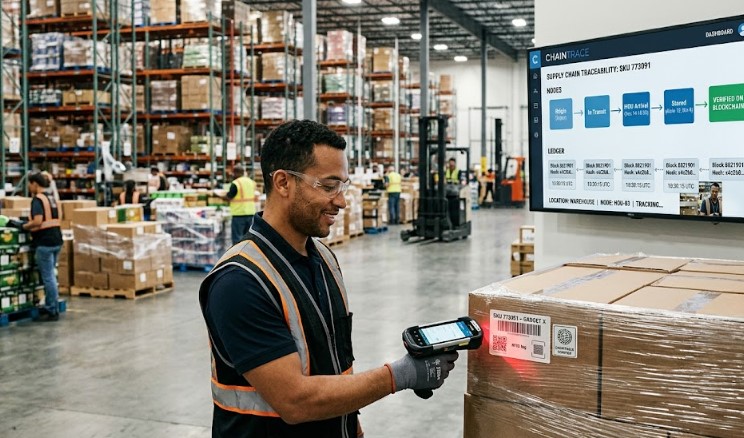
A blockchain inventory management system is a decentralized, distributed ledger-based solution that records, verifies, and tracks every inventory transaction across an entire supply chain network. Unlike conventional enterprise resource planning (ERP) systems that rely on a single centralized database controlled by one entity, a blockchain inventory system stores data across a network of nodes making every record immutable, transparent, and tamper-proof.
At its core, this technology merges two traditionally separate disciplines: blockchain distributed ledger technology (DLT) and inventory control management. Every time a product is manufactured, shipped, received, stored, or sold, that event is encoded as a cryptographic “block” and added to a permanent chain. No single party can alter or delete this data unilaterally giving every authorized stakeholder a single, shared version of the truth.
The result is a paradigm shift from reactive inventory tracking to proactive, real-time supply chain visibility — one of the most significant advancements in modern logistics technology.
How Blockchain Technology Powers Inventory Tracking
Understanding a blockchain inventory management system requires grasping four foundational concepts that distinguish it from all prior inventory technologies:
1. Distributed Ledger Technology (DLT)
Every participant in the network — manufacturers, distributors, retailers, auditors — holds an identical, synchronized copy of the ledger. There is no master database that can be hacked, corrupted, or manipulated by any single actor. This architecture delivers Byzantine fault tolerance, meaning the system continues functioning correctly even if some nodes fail or act maliciously.
2. Cryptographic Hashing & Block Validation
Each inventory event generates a data block containing a timestamp, transaction data, a unique hash identifier, and the hash of the previous block. This chaining mechanism means altering any record would invalidate every subsequent block — making historical data forensically reliable and audit-ready at all times.
3. Consensus Mechanisms
Before a new inventory transaction is confirmed, the network must reach agreement using mechanisms such as Proof of Authority (PoA) — common in enterprise permissioned blockchains — or Practical Byzantine Fault Tolerance (PBFT). These protocols ensure that only legitimate, verified inventory events make it onto the permanent record.
4. Permissioned vs. Public Blockchain Architecture
Most enterprise blockchain inventory management systems use permissioned (private) blockchains like Hyperledger Fabric, Ethereum Enterprise (Quorum), or R3 Corda — where access is controlled and only vetted parties can read or write data. This preserves confidentiality while retaining all the integrity benefits of decentralization.
“Blockchain doesn’t just digitize the supply chain — it creates an indelible, shared memory that every stakeholder can trust without needing to trust each other.”— Gartner Research, Supply Chain Technology Report
How Blockchain Technology Powers Inventory Tracking
Understanding a blockchain inventory management system requires grasping four foundational concepts that distinguish it from all prior inventory technologies:
1. Distributed Ledger Technology (DLT)
Every participant in the network — manufacturers, distributors, retailers, auditors — holds an identical, synchronized copy of the ledger. There is no master database that can be hacked, corrupted, or manipulated by any single actor. This architecture delivers Byzantine fault tolerance, meaning the system continues functioning correctly even if some nodes fail or act maliciously.
2. Cryptographic Hashing & Block Validation
Each inventory event generates a data block containing a timestamp, transaction data, a unique hash identifier, and the hash of the previous block. This chaining mechanism means altering any record would invalidate every subsequent block — making historical data forensically reliable and audit-ready at all times.
3. Consensus Mechanisms
Before a new inventory transaction is confirmed, the network must reach agreement using mechanisms such as Proof of Authority (PoA) — common in enterprise permissioned blockchains — or Practical Byzantine Fault Tolerance (PBFT). These protocols ensure that only legitimate, verified inventory events make it onto the permanent record.
4. Permissioned vs. Public Blockchain Architecture
Most enterprise blockchain inventory management systems use permissioned (private) blockchains like Hyperledger Fabric, Ethereum Enterprise (Quorum), or R3 Corda — where access is controlled and only vetted parties can read or write data. This preserves confidentiality while retaining all the integrity benefits of decentralization.
“Blockchain doesn’t just digitize the supply chain — it creates an indelible, shared memory that every stakeholder can trust without needing to trust each other.”— Gartner Research, Supply Chain Technology Report
Benefits of Blockchain-Based Inventory Management
Organizations that deploy a blockchain inventory management system report measurable improvements across operational, financial, and compliance dimensions. Here is a detailed breakdown:
Enhanced Transparency & Trust
In traditional supply chains, each party maintains its own siloed records — creating endemic mistrust, disputes, and costly reconciliation processes. Blockchain replaces this fragmentation with a shared single source of truth. Every authorized participant can verify inventory levels, shipment statuses, and product authenticity without relying on a third-party intermediary.
Significant Reduction in Inventory Fraud
Counterfeit goods, double-spending on purchase orders, and internal theft cost global businesses hundreds of billions annually. The immutability of blockchain records makes it cryptographically impossible to alter a past inventory transaction without detection — dramatically reducing opportunities for fraud at every supply chain node.
Elimination of Manual Errors
Manual data entry introduces errors at every touch point. Blockchain systems, especially when connected to IoT devices and automated sensors, eliminate human data entry for routine inventory updates — with studies showing error rate reductions of up to 80% in pilot programs.
Accelerated Dispute Resolution
When discrepancies arise between trading partners, disputes can take weeks to resolve through traditional processes. With a shared blockchain ledger, all parties reference the same timestamped, verifiable record — reducing dispute resolution time from weeks to hours or even minutes.
Regulatory Compliance & Auditability
Industries like pharmaceuticals, food safety, aerospace, and financial services face stringent traceability regulations (FDA FSMA, EU MDR, GS1 standards). Blockchain’s permanent audit trail provides automatic compliance documentation — significantly reducing the cost and complexity of regulatory audits.
Working Capital Optimization
Accurate, real-time inventory data enables more precise demand forecasting, reducing both overstocking costs (tied-up capital, storage fees, spoilage) and stockout costs (lost sales, expediting fees, customer churn). Several Fortune 500 companies have reported 20–30% reductions in safety stock requirements after blockchain deployment.
Blockchain vs Traditional Inventory Management Systems
To fully appreciate the value of a blockchain inventory management system, it helps to compare it directly with legacy approaches — centralized databases, spreadsheet-based systems, and conventional ERP platforms like SAP or Oracle.
| Feature / Attribute | Traditional Systems | Blockchain System |
|---|---|---|
| Data Architecture | Centralized database | Decentralized distributed ledger |
| Tamper Resistance | ✗ Editable by admins | ✓ Cryptographically immutable |
| Multi-Party Access | ✗ Siloed per organization | ✓ Shared, permissioned access |
| Real-Time Updates | Batch syncing (delayed) | Near-instantaneous consensus |
| Audit Trail | Manual logs (alterable) | Automatic, immutable history |
| Fraud Risk | High (single point of failure) | Very Low (distributed validation) |
| Smart Contracts | ✗ Not natively supported | ✓ Self-executing automation |
| Integration with IoT | Limited / manual | Native, automated data capture |
| Dispute Resolution Speed | Days to weeks | Hours to minutes |
| Regulatory Audit Cost | High (manual compilation) | Low (automated documentation) |
| Scalability | High (proven) | Improving (Layer-2 solutions) |
| Implementation Complexity | Moderate | High (requires ecosystem buy-in) |
Real-World Use Cases & Industry Applications
The blockchain inventory management system concept has moved well beyond theory. Here are the most impactful industry-specific applications currently deployed at scale:
🏥 Pharmaceutical & Healthcare Supply Chain
The U.S. Drug Supply Chain Security Act (DSCSA) mandates track-and-trace for all prescription drugs. Companies like MediLedger and IBM Food Trust use permissioned blockchain to trace pharmaceuticals from API manufacturer to patient dispensing — detecting counterfeit drugs and expired products in real time. This application alone could prevent an estimated 1 million deaths annually from counterfeit medicines.
🛒 Retail & Fast-Moving Consumer Goods (FMCG)
Walmart’s blockchain-based food traceability system reduced the time to trace a product’s origin from 7 days to just 2.2 seconds. Retailers use blockchain inventory systems to manage SKU-level traceability, authenticate luxury goods, prevent return fraud, and manage omnichannel inventory across thousands of locations.
✈️ Aerospace & Defense
Aviation components require lifelong, unbroken documentation. Boeing, Airbus, and defense contractors use blockchain to maintain an immutable maintenance history for every part — preventing installation of counterfeit or expired components that could compromise aircraft safety.
🌾 Agriculture & Food Safety
Cold chain monitoring — tracking temperature-sensitive perishables from farm to fork — is a natural blockchain application. Platforms like TE-FOOD and IBM Food Trust give consumers QR-code access to a product’s full journey: farm GPS coordinates, harvest date, cold chain compliance, and certification status.
⚙️ Manufacturing & Industrial Parts
Manufacturers use blockchain inventory systems to manage Bill of Materials (BOM) traceability, JIT (Just-In-Time) replenishment, and supplier qualification. When defects are discovered, blockchain enables surgical recalls — identifying only affected batch components rather than blanket product withdrawals.
💎 Luxury Goods & Anti-Counterfeiting
LVMH’s AURA blockchain gives each luxury product a unique digital identity — a non-fungible token (NFT) linked to the physical item. Buyers can verify authenticity throughout the product lifecycle, and the brand can manage secondary market inventory with unprecedented accuracy.
Smart Contracts in Inventory Automation
Smart contracts are self-executing programs stored on the blockchain that automatically enforce the terms of an agreement when predefined conditions are met. In the context of a blockchain inventory management system, they function as the automation engine — eliminating the need for manual intervention in routine inventory workflows.
Automatic Reorder Triggers
A smart contract can monitor real-time inventory levels via IoT sensor data. The moment stock of a specific SKU drops below the reorder point, the contract automatically generates and transmits a purchase order to the approved supplier — with payment terms, delivery windows, and quality specifications pre-coded into the contract logic.
Conditional Payment Release
Rather than paying invoices on fixed terms, smart contracts release payment only when delivery confirmation data (from RFID or IoT sensors at the receiving dock) is written to the blockchain — eliminating accounts payable fraud and accelerating supplier payment cycles.
Quality Gate Enforcement
In pharmaceutical or food supply chains, smart contracts can be programmed to reject shipments automatically if temperature excursion data from IoT cold chain loggers exceeds allowable thresholds — a process that previously required human inspection and paperwork.
Warranty & Recall Management
Smart contracts tied to product serial numbers can automatically initiate recall notifications, freeze sales of affected inventory, and trigger replacement workflows — compressing recall timelines from months to days.
Challenges & Limitations of Blockchain Inventory Systems
Despite its transformative potential, implementing a blockchain inventory management system is not without significant challenges. Decision-makers must weigh these carefully:
- High Implementation Cost: Initial deployment — including infrastructure, smart contract development, integration with legacy ERP systems, and staff training — can range from $500K to several million dollars for enterprise-scale projects.
- Ecosystem Buy-In Required: Blockchain’s value multiplies when all supply chain participants use the same network. Convincing suppliers, logistics providers, and retailers to adopt a new system simultaneously is a significant coordination challenge.
- Scalability Constraints: Public blockchains like Ethereum process 15–30 transactions per second — insufficient for high-volume retail inventory. Permissioned chains (Hyperledger Fabric) handle thousands of TPS but require enterprise infrastructure.
- The “Oracle Problem”: Blockchain guarantees the integrity of data once it’s on the chain — but cannot verify the accuracy of data as it enters the chain. A corrupted IoT sensor or dishonest data entry at the point of origin undermines the entire system.
- Regulatory Uncertainty: In many jurisdictions, the legal status of smart contract enforceability and blockchain records as legal evidence remains unsettled.
- Legacy System Integration: Most enterprises run decades-old ERP systems. Building reliable APIs between legacy infrastructure and blockchain networks requires significant middleware development.
- Skills Shortage: The global pool of blockchain developers with supply chain domain expertise remains small, driving up implementation costs and project timelines.
How to Implement a Blockchain Inventory Management System
A successful blockchain inventory management deployment follows a structured methodology. Here is the proven implementation roadmap used by leading enterprises:
Phase 1: Strategic Assessment & Use Case Prioritization
Begin by mapping your current inventory pain points — high shrinkage, supplier disputes, compliance gaps, counterfeit exposure — and ranking them by financial impact. The highest-ROI use cases (typically traceability, fraud prevention, or compliance documentation) should anchor the initial blockchain implementation rather than attempting a full-system overhaul at once.
Phase 2: Platform Selection
Choose between leading enterprise blockchain platforms based on your specific requirements:
- Hyperledger Fabric — Best for complex, multi-organization supply chains requiring granular access controls and high transaction throughput.
- Ethereum (Quorum/Besu) — Ideal for organizations leveraging existing Ethereum developer talent and requiring smart contract flexibility.
- VeChainThor — Purpose-built for supply chain management with native IoT integration and enterprise tooling.
- R3 Corda — Designed for regulated industries (financial services, healthcare) with built-in privacy and legal agreement frameworks.
Phase 3: Network Design & Governance
Define who participates in the blockchain network, what data each participant can read or write, how consensus is achieved, and how governance disputes are resolved. This network governance model is arguably more critical to project success than the technology selection itself.
Phase 4: IoT & RFID Integration
Connect physical inventory to the digital ledger through IoT sensors, RFID readers, GPS trackers, and barcode scanners. Establish data standards (GS1 EPCIS, for example) to ensure interoperability across the ecosystem.
Phase 5: Pilot Program & Iteration
Launch with a limited pilot — a single product category, supplier, or warehouse — before scaling. Use the pilot to identify integration gaps, refine smart contract logic, and measure KPIs against baseline inventory performance metrics.
Phase 6: Full-Scale Deployment & Change Management
Scale the network iteratively, onboarding additional participants and supply chain tiers. Invest heavily in change management — training warehouse staff, redefining workflows, and establishing new KPIs aligned to blockchain-enabled capabilities.
Future Trends: AI, IoT, and Blockchain Convergence
The blockchain inventory management system of 2025 is already evolving toward a more intelligent, interconnected architecture. Several converging technology trends will fundamentally reshape this space in the next 3–5 years:
AI-Augmented Blockchain Inventory
Artificial intelligence and machine learning models are being layered on top of blockchain data lakes to enable predictive inventory optimization. Rather than simply recording what happened, these systems forecast future demand with significantly higher accuracy — using immutable historical data as training inputs that cannot be manipulated or cherry-picked.
IoT + Blockchain: The Autonomous Supply Chain
As IoT device density increases — with connected sensors, autonomous mobile robots (AMRs) in warehouses, and GPS-enabled shipping containers — the volume of real-time data flowing into blockchain inventory systems will grow exponentially. The result is a self-monitoring, self-reporting inventory network that operates with minimal human intervention.
Asset Tokenization & Inventory Finance
Tokenizing physical inventory assets on blockchain networks enables novel financial instruments — inventory-backed tokens that can be used as collateral for instant financing, fractional ownership of commodity stocks, or automated hedging strategies. This intersection of blockchain inventory and decentralized finance (DeFi) could unlock trillions in previously illiquid working capital.
Cross-Chain Interoperability
As different industry consortia build separate blockchain networks, cross-chain bridges and interoperability protocols (like Polkadot, Cosmos IBC, and Hyperledger Cacti) will enable seamless data exchange across previously siloed supply chain blockchains — creating truly global, unified inventory visibility.
Quantum-Resistant Cryptography
As quantum computing matures, the cryptographic foundations of current blockchain systems will require upgrading. The NIST Post-Quantum Cryptography standardization initiative is already shaping next-generation blockchain inventory systems designed to remain secure in a post-quantum world.