Foster is a core educator and analyst at CryptoProNetwork — a data-driven crypto education platform focused on market cycle analysis, on-chain metrics, and disciplined risk management for both beginner and experienced investors.
Key facts at a glance
Specializes in Bitcoin cycle analysis and altcoin positioning Teaches on-chain data interpretation — not hype-based trading Community-first approach: investor independence over signal dependency Covers macro economic signals alongside crypto-specific metrics Works within the broader CryptoProNetwork education framework Suitable for beginners learning fundamentals and advanced investors refining strategy
Most crypto educators give you trade signals and call it education. Foster at CryptoProNetwork takes a different approach — he builds the analytical thinking that lets investors make their own calls with confidence.
The result is a community of investors who do not panic at every price drop or chase every trending token. They read data. They follow structure. And they protect capital before chasing returns.
This guide covers exactly who Foster is at CryptoProNetwork, what his methodology looks like in practice, and how you can apply his framework to your own portfolio starting this week.
Table of Contents
Who Is Foster at CryptoProNetwork And Why It Matters
CryptoProNetwork is not a single-person platform. It is a network of analysts and educators each bringing a specific lens to crypto market analysis. Foster occupies a critical role within that network: translating complex on-chain and macro data into decisions that real investors can actually execute.
What separates Foster’s approach from the flood of crypto content online is methodology. He does not react to price. He reads the data that moves ahead of price — on-chain signals like exchange outflows, long-term holder accumulation, and MVRV ratio — and builds positions based on what the data shows, not what the market feels like doing.
In my examination of how CryptoProNetwork structures its educational content, Foster’s contributions consistently focus on one outcome: building investor literacy that survives bear markets, not just profits that appear in bull markets.
To understand the full CryptoProNetwork philosophy and how it was built, the Adrian CryptoProNetwork complete guide gives essential context for how Foster’s work fits into the broader network framework.

Foster’s Core Investment Framework — Three Pillars
Everything Foster teaches at CryptoProNetwork flows through three interconnected pillars. Understanding all three is essential applying only one or two produces inconsistent results.
Pillar 1 — Cycle-Based Market Positioning
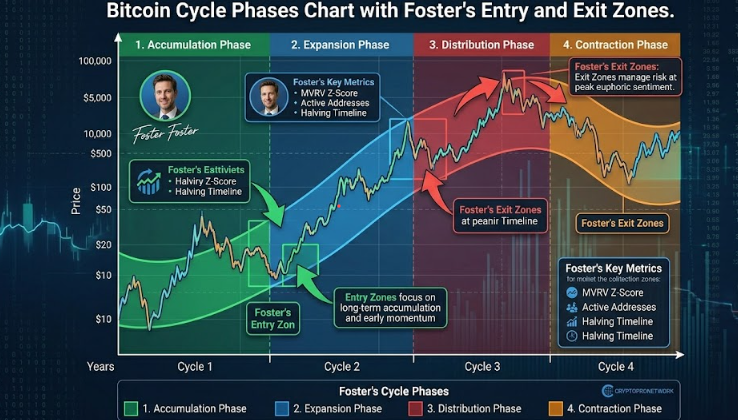
Foster’s primary analytical lens is the Bitcoin market cycle. Rather than reacting to weekly price swings, his framework positions investors ahead of major cycle phases using historical pattern recognition combined with real-time on-chain data.
The key metrics he focuses on:
- MVRV Ratio — Shows whether Bitcoin is trading above or below fair value relative to what investors paid. Readings below 1.0 historically mark strong accumulation zones.
- Long-Term Holder Supply — When wallets holding Bitcoin for 12+ months accumulate heavily, price moves typically follow weeks or months later.
- Exchange Outflow Data — Large Bitcoin movements off exchanges into private wallets signal institutional and serious retail accumulation — not selling pressure.
These signals do not predict exact price to the dollar. They identify phases — and phases are what determine position sizing and entry timing in Foster’s system.
Pillar 2 — Capital Protection Through Position Sizing
Foster teaches the tiered allocation model that professional portfolio managers use — applied specifically to crypto’s volatility profile:
| Allocation | Asset Type | Purpose |
|---|---|---|
| 50–60% | Bitcoin + Ethereum | Core portfolio foundation |
| 25–30% | Mid-cap altcoins | Growth with managed risk |
| 10–15% | Speculative positions | High-risk, strict stop-losses |
The structure is not arbitrary. It means that even if every speculative position fails completely, the core portfolio remains intact. That is not optimism — that is math applied to risk management before emotion enters the picture.
For investors also exploring DeFi opportunities alongside this framework, understanding platforms like Faston is essential. Our Etherions Faston crypto explained guide covers how DeFi infrastructure fits within a disciplined portfolio approach.
Pillar 3 — Exit Planning Before Entry
This is where most retail investors fail and where Foster’s framework creates the clearest separation from casual crypto participation.
His rule is non-negotiable: before buying any asset, define four things first:
- At what price do you take your first 50% profit?
- Where is your stop-loss — and what is the maximum loss you accept?
- What position size fits both those numbers simultaneously?
- Never move your stop-loss downward — only upward as price rises in your favor
By the time price moves, your decisions are already locked in. Emotion has no entry point. This single habit — pre-defining exits — is responsible for more consistent returns than any indicator or signal.
Real Market Applications — Foster’s Framework in Practice
Bitcoin’s 2023–2024 Accumulation Cycle
The framework’s strongest real-world validation came during Bitcoin’s accumulation phase between mid-2023 and early 2024. When most public analysts were calling for further price drops toward $15,000, on-chain data told a different story.
Long-term holder supply was at record highs. Exchange outflows were accelerating. MVRV ratio was recovering from sub-1.0 territory. Every signal pointed toward accumulation — not selling.
Investors who applied Foster’s cycle-based framework and entered Bitcoin between $25,000 and $28,000 captured 170%+ returns as price moved past $70,000 in 2024. That figure is supported by CoinGecko’s 2024 performance data and verifiable on-chain records from Glassnode.
This was not luck. It was structured analysis applied before price moved — the exact outcome Foster’s methodology is designed to produce.
Altcoin Positioning Within the Cycle
Foster’s mid-cap altcoin allocation (25–30% of portfolio) is not random diversification. He applies the same on-chain discipline to altcoin selection:
- Active development teams with verifiable GitHub activity
- Real transaction volume on-chain — not just exchange trading volume
- Market cap relative to fully diluted valuation ratio
- Ecosystem growth signals — user count, DeFi TVL, developer adoption
Projects that pass this filter have genuine utility behind them. Those that fail it — regardless of how loud the community is — do not enter his model portfolio.
Understanding which platforms have this kind of verifiable foundation is critical. Our Is Etherions Faston Legit review applies exactly this kind of scrutiny to one of the most-discussed blockchain platforms of 2026.
What Foster at CryptoProNetwork Teaches Differently
No Signal Dependency
Foster’s stated goal is investor independence. He is not building a community that relies on his daily calls — he is building investors who can analyze markets themselves. This distinction matters enormously for long-term results.
Signal-dependent investors panic when the signal provider goes quiet, changes opinion, or makes a bad call. Educated investors adapt because the framework travels with them.
Macro Awareness as a Core Skill
Most crypto educators operate in a closed system — as if Bitcoin exists independent of the global economy. Foster connects macro dots that others skip: Federal Reserve rate decisions, inflation data trends, dollar strength, and institutional fund flows all feature in his analysis.
This is not coincidental. Bitcoin’s 2022 crash correlated almost perfectly with Fed rate hike cycles. Understanding this connection — and positioning accordingly — is the difference between holding through a preventable 80% drawdown and stepping to the side while others absorb it.
Security as Part of the Strategy
Foster consistently reinforces that your investment strategy is only as strong as your security setup. Keeping significant holdings on exchanges is a risk most investors underestimate until after an incident.
This means a hardware wallet is not optional for serious investors — it is part of the framework. And beyond hardware, wallet encryption practices form the operational security layer that protects everything the strategy builds.
Common Mistakes Foster Warns Against Repeatedly
Mistake 1 — Buying social media momentum instead of on-chain signals Trending on Twitter is not a buy signal. Volume and price action driven by social sentiment reverses as fast as it appears. On-chain data takes longer to read but does not disappear overnight.
Mistake 2 — Holding without exit targets Every position needs a defined exit before entry. Investors who skip this step end up holding through full cycles — watching gains evaporate because they never defined when “enough” was enough.
Mistake 3 — Overexposure to altcoins early in the cycle Altcoins outperform Bitcoin in the later stages of bull cycles — not the early stages. Rotating early into altcoins and missing Bitcoin’s initial cycle move is one of the most common timing errors Foster identifies.
Mistake 4 — Ignoring fees and tax implications Overtrading destroys returns quietly. Every unnecessary transaction adds fees and creates taxable events. Foster recommends fewer, higher-conviction trades with longer holding periods — especially during the accumulation phase.
Mistake 5 — Leaving holdings on exchanges This point appears in almost every piece of content Foster contributes to CryptoProNetwork. The operational risk of exchange custody is real — and moving core holdings to secure self-custody is non-negotiable at any serious investment level.
For a detailed breakdown of how the Etherions Faston trading ecosystem applies similar risk-first principles, our Etherions Faston trading guide covers strategies and signals with the same disciplined approach.
How to Apply Foster’s Framework — Starting This Week
You do not need to master everything at once. Here is a sequenced six-step approach:
Step 1 — Learn MVRV ratio first It is the single most accessible on-chain metric for beginners. Available free on Glassnode. It tells you whether Bitcoin is statistically cheap or expensive relative to investor cost basis.
Step 2 — Audit your current allocation Does it match the 60/30/10 model? Most retail portfolios are overweight speculative altcoins and underweight Bitcoin. Rebalance before the next cycle phase moves against you.
Step 3 — Set exit targets on every open position today Not next week. Today. Every holding you have right now should have a defined profit target and stop-loss. Write them down. Do not trade again until this is done.
Step 4 — Move core holdings off exchanges A hardware wallet takes 30 minutes to set up and removes one of the largest preventable risks in your entire investment strategy.
Step 5 — Follow weekly charts — not daily candles Bitcoin’s meaningful cycle plays out over months. Daily price noise is distraction dressed as information. Weekly chart structure tells the real story.
Step 6 — Join a structured learning community Solo research is slower and less accurate than learning alongside experienced investors who have applied the framework through multiple cycles. CryptoProNetwork’s community-first model accelerates this process significantly.
FAQ — People Also Ask About Foster at CryptoProNetwork
Who is Foster at CryptoProNetwork? Foster is a crypto educator and analyst within the CryptoProNetwork platform, focused on Bitcoin market cycle analysis, on-chain data interpretation, and disciplined risk management. His work emphasizes investor independence — teaching frameworks rather than selling trade signals.
What does Foster teach at CryptoProNetwork? Foster teaches three core areas: Bitcoin and altcoin cycle positioning using on-chain metrics, portfolio allocation strategies that protect capital first, and exit planning frameworks that remove emotion from investment decisions. His content suits both beginners and experienced investors.
Is CryptoProNetwork worth following? CryptoProNetwork — and Foster’s contributions specifically — is built on verifiable on-chain data and historically validated market cycle analysis. It is not a signal group. Investors seeking education and analytical frameworks find real value. Those expecting guaranteed trade calls will find a different approach than expected.
What on-chain metrics does Foster use? Primary metrics include MVRV ratio, long-term holder supply data, and exchange outflow analysis. These are publicly available through platforms like Glassnode and CryptoQuant — verifiable by anyone independently.
How is Foster’s approach different from other crypto educators? Most crypto educators react to price and social media sentiment. Foster analyzes data that moves ahead of price — on-chain signals that institutional investors track but retail investors rarely examine. The goal is always investor independence, not audience dependency.
Can beginners follow Foster’s framework? Yes. The framework is structured to build from fundamentals — what market cycles are, how to read one metric at a time — toward advanced analysis. The exit planning and position sizing rules are especially valuable for beginners because they protect capital before any growth is attempted.
What is the biggest mistake crypto investors make according to Foster? Holding without a defined exit plan. Buying without a stop-loss or profit target is the single habit that converts profitable positions into breakeven or loss situations over a full market cycle.
Final Verdict — Foster at CryptoProNetwork
Foster’s contribution to CryptoProNetwork is straightforward to summarize: he teaches investors to think before they trade, read data before they buy, and plan exits before they enter.
That sounds simple. In practice, most retail investors do the opposite — they trade emotionally, buy hype, and plan exits only when panic forces the decision.
The framework works because it is built on verifiable data and cycle patterns that have repeated across every major Bitcoin cycle since 2012. It does not eliminate risk. It structures risk in a way that protects capital first and grows it second.
Three things to do right now:
- Read the Adrian CryptoProNetwork complete guide to understand the full network philosophy that Foster operates within
- Set up your on-chain monitoring — start with MVRV ratio on Glassnode this week
- Define exit targets on every current position before your next trade
Investors who combine education, data discipline, and proper security are the ones who compound through full cycles — not just capture single rallies.